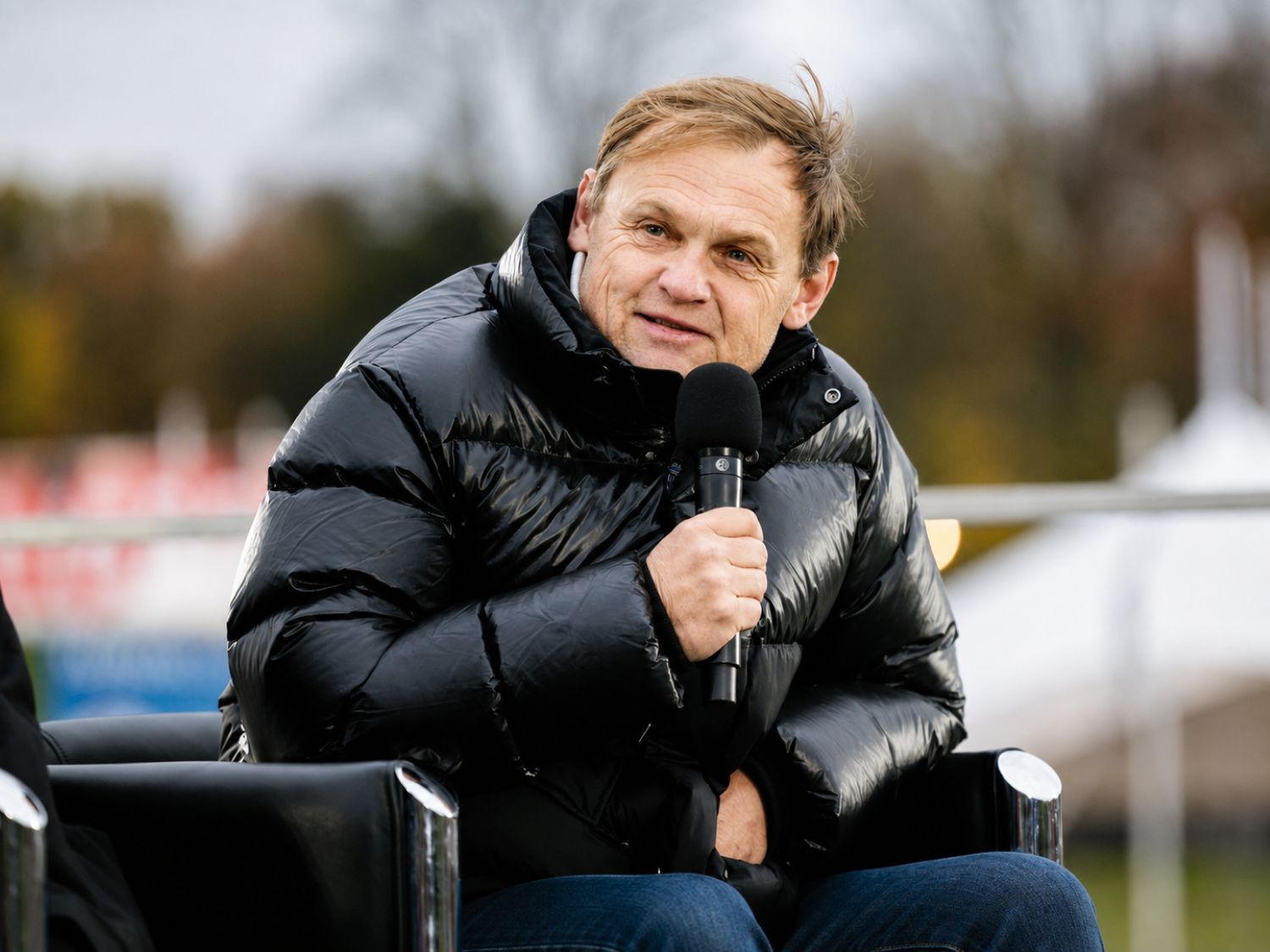
On a stage in Erlangen, before an audience of engineers, Bjørn Gulden was handed a shoe. Siemens had produced it using a 3D printer and presented it proudly after displaying it at the Hannover Fair. When asked what he thought, Gulden requested permission to be honest and turned it over.
First came the heel. It carried the Siemens name. With that logo, he calculated, the shoe was worth half as much as it would be with Adidas printed on it. That difference came from emotion, not engineering.
Second, the demonstration was slightly misleading. What had been printed was the sole, not the entire shoe; the upper still came from Asia.
Then came his main objection. The shoe had been measured while resting on a plate.
“People do not buy shoes to stand still, unless they are bakers. People run.”
The speaker was Bjørn Gulden, the Norwegian executive who has served as CEO of Adidas since January 2023. The scene captures something about his management style. He discusses the product before the strategy and does so openly, even when the CEO of Siemens is sitting beside him. In March 2026, the Adidas Supervisory Board extended his appointment through December 31, 2030.
A bad signing
Before running companies, Bjørn Gulden played professional football. He was a midfielder for 1. FC Nürnberg in the German Bundesliga and for the Norwegian clubs Bryne and Strømsgodset.
His own assessment of that stage is brief and not particularly generous to the club: he says he was a bad signing.
Gulden nevertheless considers that unsuccessful football career his best education. The argument is organizational rather than sentimental.
In a team, a person must play alongside people who are better or worse, people they like and people they do not, and still find a way to fit in. School and university subjects can be studied. Social skills, he argues, are learned only through experience.
His corporate career later took him through Helly Hansen, the German footwear retailer Deichmann and the American businesses Rack Room Shoes and Off Broadway Shoes. Between 2012 and 2013, he led the Danish jewelry company Pandora.
In July 2013, he became CEO of Puma. He spent nine years there and helped return the company to the front rank of the global sportswear market. In November 2022, he announced that he would not renew his contract, and a few weeks later Adidas confirmed his appointment.
The 2025 financial results reflect the scale of the turnaround. Adidas reported record revenue of €24.811 billion, operating profit of €2.056 billion and an operating margin that increased from 5.6 percent to 8.3 percent.
Messi size
About half an hour from the company’s headquarters, Adidas maintains a workshop in Scheinfeld where approximately 5,000 pairs of shoes are handmade each year.
They are produced for the company’s leading athletes using lasts molded from each individual foot.
Gulden explains the idea through an image more effective than any technical specification: Messi does not play in size 38½. He plays in size “Messi.”
The customization extends far beyond fit. Footballers often ask for their boots to carry the embroidered names of their partners, children or entire families.
They receive four or five pairs each quarter and keep them afterward.
Gulden preserves the workshop more for what it represents than for its profitability. Having a place half an hour from the office where products are made for elite athletes allows the wider company to see closely how the brand works.
He believes that this is worth more than any advertising campaign and says it will remain that way for as long as the decision belongs to him.
The same logic explains his caution toward 3D printing.
Adidas already sells a shoe produced almost entirely through printing, without conventional manual assembly. It costs around €160 in Germany and emerges from the production process one unit at a time.
Gulden admits that the company earns almost nothing from it and that the material has not yet achieved the same combination of softness and firmness as a conventional shoe.
For now, he treats it as a demonstration of innovation rather than a business line.
He suspects that industrial scale may arrive first from China, where some companies already operate large spaces filled with printers working simultaneously.
When asked whether Adidas is a fashion brand or a technology company, Gulden answers from a broader understanding of the business.
Neither. It is a sports company.
He also offers some internal criticism. Adidas once defined itself as a technology company, he says, and that was where it became completely lost.
The figure he uses to demonstrate the true size of the market is striking: around 4.3 pairs of running shoes are sold per person in the United States.
How many Americans, he asks, actually run?
Models who do not exist
Adidas directly employs approximately 65,000 people and supports more than one million workers indirectly when its global production network is included.
At its headquarters in Herzogenaurach, the company is already testing hundreds of artificial intelligence applications.
Gulden explains clearly what that means.
In e-commerce, some of the models wearing and presenting products are already ceasing to be real people. They are synthetic humans created by combining elements generated through artificial intelligence.
The exception comes when identity is part of the message.
In that case, it must be Messi. It must be the real and recognizable Messi, not an artificial reconstruction.
Once that distinction matters, producing the image and developing the content become a different kind of work.
The second challenge is commercial.
According to Gulden, redesigning the supply chain over the previous two years was chaotic because tariffs changed from month to month and the company could not predict how much it would ultimately cost to bring merchandise into the United States.
After the US Supreme Court struck down emergency tariffs, Gulden said Adidas could be entitled to a refund of US$300 million. The company had not yet recorded the amount in its accounts, although he described the chances of recovering it as strong.
When asked what keeps him awake at night, he does not mention tariffs, supply chains or artificial intelligence.
He says that 80 percent of his thoughts are about people.
The World Cup gave Adidas its strongest football quarter in the company’s history. The brand sold between three and four times as many shirts as during the previous tournament and twice as many footballs.
The final results were scheduled to be released on July 30.