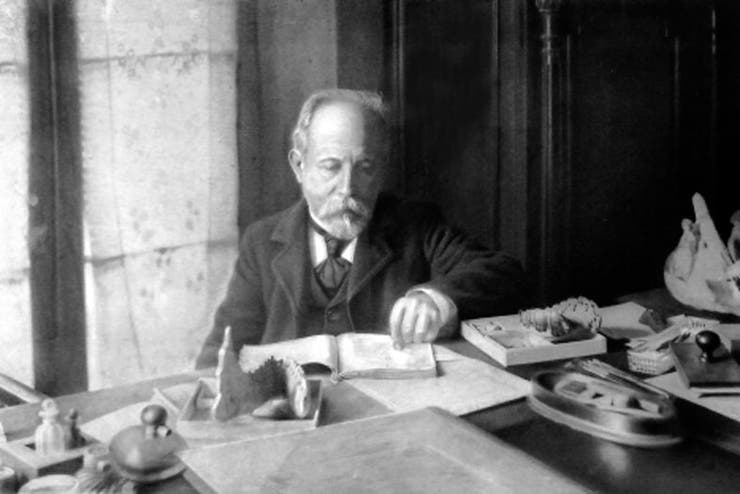
As a child, he was told that the atoms in his body renew themselves every seven years, and he could not stop thinking about it. Forty years later, he runs Spotify and wants to give 760 million people more control over what they listen to.
Someone told him when he was young that 99% of the atoms in the human body are replaced every seven years. The idea stayed with him for a reason that had nothing to do with science.
If the atoms disappear, he reasoned, then he could not simply be his atoms. A rock is: look at it, come back seven years later, and the same atoms are still there. With a person, that is not the case. His provisional conclusion was that a person is the structure of those atoms, and another word for structure is information.
Then that answer was taken away from him too. If someone thinks about the same thing for a long time, the brain changes shape. Playing the piano for years develops the brain’s musical center. The classic example is London taxi drivers, who have to memorize the entire city and show an enlarged area associated with three-dimensional thinking on brain scans. So structure is not fixed either: what a person thinks rearranges the atoms, and those atoms eventually disappear as well.
Only one thing remains constant: processing. You are your thoughts. Literally, he clarifies, not as an analogy.
Gustav Söderström is 50 and has served as Spotify’s co-CEO alongside Alex Norström since early 2026. He says that childhood conclusion is what eventually led him to artificial intelligence. If human beings are information processing, then a machine that processes information raises a question about ourselves. At university in the late 1990s, he tried to build neural networks, but nothing much happened: computers were too slow and the results were disappointing. He put the idea aside for fifteen years.
Nobody Regrets Going for a Run
The internal strategy is called No Regrets, and Spotify is only now talking about it publicly. The idea is not to measure how much time people spend on the platform, but how they feel afterward.
It grew out of an anonymous third-party survey covering all the major media platforms, including Spotify. The question was how people felt about the time they had spent and, conversely, how much of that time they regretted. Spotify recorded the lowest level of regret, with Gen Z users valuing close to 90% of the time they spent there. What surprised Söderström was the other side of the results: on several major platforms, young people regretted 60% or more of the time they had spent. He had assumed they were there because they wanted to be. Instead, they said they felt trapped.
That metric guides product decisions, and sometimes it costs money. When podcasts became video-based, many parents complained that they had given their children Spotify to listen to, not to watch. The company introduced the option to disable video entirely, for both free and paying users. It is an explicit decision against maximizing usage, and Söderström supports it: if you are going to have principles, you have to live with the consequences.
Spotify can afford to think that way because of its business model: almost 90% of its revenue comes from subscribers. Someone who votes with their wallet every month is not paying for how much time they spent, but for the value they felt they received. If pure usage were the goal, he jokes, being stuck in traffic would be the best product in the world. That is why one of the metrics they pursue is how many times a month a user comes back.
The same principle shapes where Spotify expands. Fitness is one example, because nearly 70% of Spotify users exercise with Spotify and because nobody regrets working out. His example is obsessively precise, and personal because he runs: asking the app for a playlist designed for an eight-minute mile, based on his musical taste, with the beat landing on every footstep. The system has to calculate steps per minute, find songs at that tempo or half of it, speed them up or slow them down to the exact number, mix them with the right transitions, and then layer in a voice announcing when each interval begins.
Premeditated Media
Söderström read the paper that helped launch the current era of artificial intelligence, “Attention Is All You Need,” within days of its publication in 2017 and began talking about it with anyone who would listen. Spotify started investing before there was a clear use case: it acquired a voice-generation company when models were not yet capable of writing the scripts those voices would read. The logic, he says, was to intercept the curve rather than wait for it.
What emerged from that work is what he calls a taste model. A language model learns from sequences of words and predicts what comes next; Spotify trains the same architecture on trillions of listening sequences, allowing the model to predict the next song. The difference from traditional recommendation systems is that users can now answer back. The product explains, in plain language, who the platform thinks the user is and allows them to say that it is wrong: this may be what I listen to, but it is not who I want to become.
That is the heart of his bet, and he presents it as a position against the prevailing current. He acknowledges that generative AI has everything needed to create the most addictive algorithm in history, because nothing has ever understood an individual so well. But he insists that it is a dual-use technology and that companies can choose the other path.
He takes the idea to an extreme in his own life. He built an agent that prepares a daily audio briefing containing the subjects he cares about while explicitly filtering out rage-inducing content, clickbait and politics. His admitted weakness is road-rage videos: he finds them fascinating and can lose hours watching ordinary people ruin their lives inside a car. Now he tells the agent not to show them to him.
He calls this premeditated media. The idea is that most people have a fairly good sense of what they want, but get caught in the moment: if someone puts a piece of candy in front of you, you take it. The more interesting question, then, is whether people can be given the opportunity to decide their future in advance.
It is the same question about atoms, dressed differently. If a person is what they process, choosing what enters the system stops being merely a matter of information hygiene and becomes something much more literal.