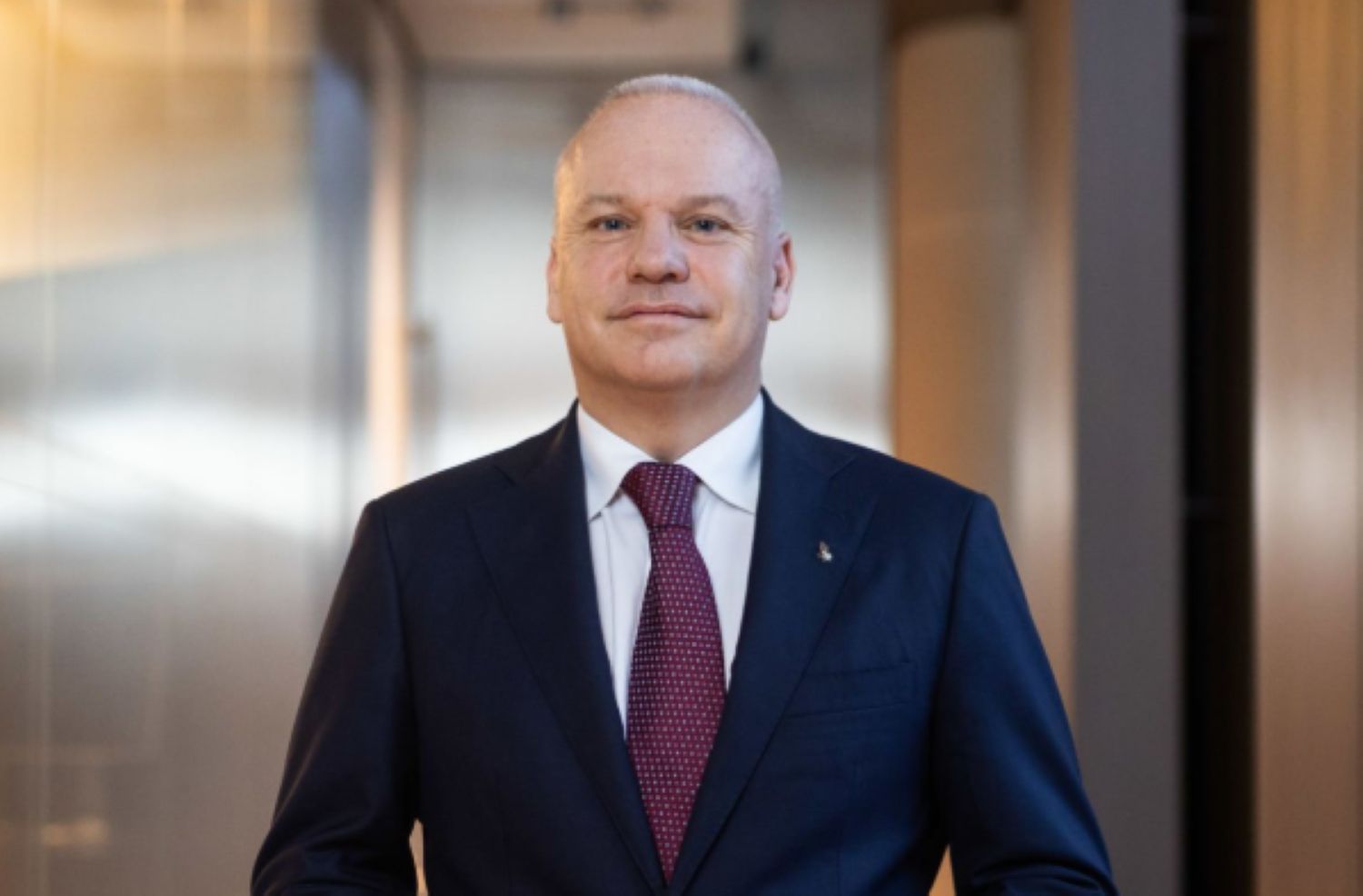
In the European autumn of 2021, Anders Opedal began looking at numbers that did not quite add up.
It was the time of year when Europe usually fills its gas storage facilities in preparation for winter. But that year something was wrong. Storage levels were not rising at the usual pace, and less gas was arriving from Russia week after week, without much explanation.
Equinor did not control those volumes. It could only look at production, import and storage data and try to understand what was behind the signal.
Inside the company, different hypotheses began to be discussed. Perhaps it was a technical problem. Perhaps maintenance was taking longer than expected. Perhaps there was some operational issue on the Russian side.
Opedal tells the story without dramatizing it: they could not figure it out.
The answer came months later. In February 2022, with Russia’s invasion of Ukraine, it became clear that what they had observed during the previous autumn was not simply a technical issue.
In his case, there was a particular irony to the situation. Opedal is an engineer and had specialized, precisely, in acoustics and signal processing. He studied hydroacoustics and geoacoustics and, for a time, even considered working in medical acoustics and ultrasound.
But his career took another direction.
He joined Equinor in 1997 and has spent almost his entire professional life inside the company. He lives in Stavanger, a city deeply connected to Norway’s oil industry, and has served as president and CEO since November 2020.
When the war began, concern over Europe’s energy supply stopped being a technical warning and moved to the center of global politics.
Countries across Europe and the United Kingdom began asking Equinor whether it could increase gas production.
The answer was not simple.
Opedal often explains that Equinor does not operate like some of the large Middle Eastern producers that have substantial spare capacity available. Norwegian fields were already producing close to their maximum levels.
The alternative was to look for smaller improvements.
Hundreds of engineers and operators reviewed processes and operations to identify places where a little more production could be extracted. None of those improvements changed the picture very much on its own, but together they could add up to meaningful volumes.
It is a good illustration of the scale of the operation he now leads.
The Norwegian state owns 67% of Equinor. The company employs around 24,000 people, approximately 18,000 of them in Norway, and produces close to 2.1 million barrels of oil equivalent per day, divided roughly equally between oil and gas.
Virtually all the gas it produces ends up in Europe. The same is true of between 90% and 95% of its oil.
When much of Russia’s crude stopped reaching the European market, refineries began partially replacing it with Norwegian oil, which also has similar characteristics.
The war therefore made Equinor an even more important part of Europe’s energy security.
Opedal often returns to those years when discussing how the energy debate changed.
As he recalls it, in 2020 and 2021 much of the conversation was focused on sustainability. Security of supply and energy prices received considerably less attention.
The disappearance of much of the Russian supply suddenly brought those issues back to the forefront.
Nor does he see Equinor as simply a beneficiary of the crisis. The company increased its revenue, but it also paid much more in taxes. In Norway, oil and gas extraction activities are subject to a 78% tax burden.
At the same time, high energy prices ultimately affected the cost of living for millions of people.
For Opedal, the experience left one fairly clear idea: energy policy cannot focus only on sustainability, security of supply or price. It has to try to sustain all three at the same time.
That balance has not been easy to maintain inside Equinor either.
In 2020, the company set a target of reaching between 10 and 12 gigawatts of renewable capacity by 2030, with a significant commitment to offshore wind.
Conditions changed.
It currently has around six gigawatts under development and no longer expects to reach the earlier target.
Opedal talks about the issue without much hesitation. Competition for licenses drove project costs higher and, in several rounds, Equinor decided not to participate because it concluded that the economics no longer worked.
The total cost of some projects increased by close to 50%, largely because of higher prices for turbines and other components.
He also points out that several of the projects that won those auctions were ultimately never built. Some companies had offered prices that later proved difficult to sustain once costs changed.
One of Equinor’s most visible cases occurred off the coast of New York. The wind project it was developing there was halted after the Trump administration took office and was able to continue after a legal dispute.
Situations like that help explain another of Opedal’s recurring concerns: the lack of continuity in energy policy.
An investment on this scale requires decades.
As he explains it, preparing a project can consume almost an entire electoral cycle. Building it can take another, and recovering the invested capital requires several more.
If the rules change dramatically during that period, many of the assumptions behind the original decision cease to exist.
That is why he generally avoids entering partisan debates. When asked whether he hoped for a change of government in the United Kingdom that might make some projects easier, he replied that he does not comment on which government should win an election in another country.
With methane, the discussion is different.
Equinor records methane emissions considerably below the industry average. Opedal often explains that this did not arise solely from concern about climate change.
A gas leak is also a safety problem.
For decades, Norwegian regulation required companies to measure even small losses and maintain fairly strict control over their facilities.
At the same time, parts of the oil and gas industry began lobbying in Brussels to delay new European rules on methane emissions. The campaign became known as Stop the Clock.
When asked about that position, Opedal raised a technical objection.
According to him, an early version of the regulation could, in practice, have required operations on the Norwegian continental shelf to be stopped very frequently in order to carry out certain measurements.
His argument was that a rule of that kind should also be discussed with the engineers responsible for operating the facilities.
During the interview, he was told that questioning technical aspects of a regulation was not exactly the same as asking for its implementation to be delayed.
Opedal acknowledged the distinction and returned to the need for regulators and companies to work together. He also said he would like other companies in the industry to apply standards similar to those Equinor uses to control its own emissions.
The problem extends beyond the Norwegian company.
According to World Bank data cited during the conversation, routine gas flaring, a practice the industry committed to reducing and ultimately eliminating, increased by around 3% over the past year.
Equinor has also spent years working on another technology that is progressing considerably more slowly than it had hoped: carbon capture and storage.
Norway has decades of experience storing carbon dioxide beneath the seabed. Building on that knowledge, Equinor developed Northern Lights together with Shell and TotalEnergies, with support from the Norwegian state.
The project includes different stages, from capturing CO2 at industrial facilities to transporting and permanently storing it.
The available infrastructure makes it possible to envision volumes far greater than today’s.
Capacity linked to these developments could reach tens of millions of tonnes per year, but current utilization remains far below that level.
Between 2021 and 2023, Opedal says, many companies were asking whether they could have carbon-capture systems operating before 2030. That interest later weakened.
The problem is largely economic.
For a heavy industry company to decide to capture its CO2, the cost of doing so has to be competitive with the price it pays for emitting carbon.
According to the calculations Opedal often cites, that price would need to approach €200 per tonne for many projects to make economic sense without depending on additional subsidies.
It is currently well below that level.
That gap helps explain why a technology that has existed for years is still not being deployed at the speed many had expected.
When asked what kind of leadership the current moment requires, Opedal tends to talk less about taking major risks and more about sustaining decisions through difficult periods.
During his first five years as CEO, he had to navigate a pandemic, an energy crisis and two wars.
For him, one of the challenges is maintaining a long-term decision when criticism or short-term results make it appear mistaken.
That approach has also begun to change the way Equinor trains its future leaders.
The company introduces complex business dilemmas relatively early in employees’ careers, even when many of them are still working within highly specialized areas.
The aim is to see how they respond when there is no obvious solution and they have to consider problems beyond their own area of expertise.
At the end of a long interview, the journalist pointed out something that had appeared repeatedly throughout the conversation even though it had not been among the planned questions.
Opedal had mentioned safety in several of his answers.
He replied that it comes first.
His standard is fairly simple: if an activity cannot be carried out safely, it is not worth doing.
In his case, safety appears both when he talks about people and when he explains technical issues. It also lies behind methane-leak controls, the operation of facilities and many of the operational decisions the company makes.
It is a perspective that fits closely with his engineering background and with the type of company he has led since 2020.
Opedal trained to interpret signals. Nearly three decades after joining Equinor, much of his work still involves something similar: looking at incomplete data, understanding what is changing and making decisions before all the answers are available.