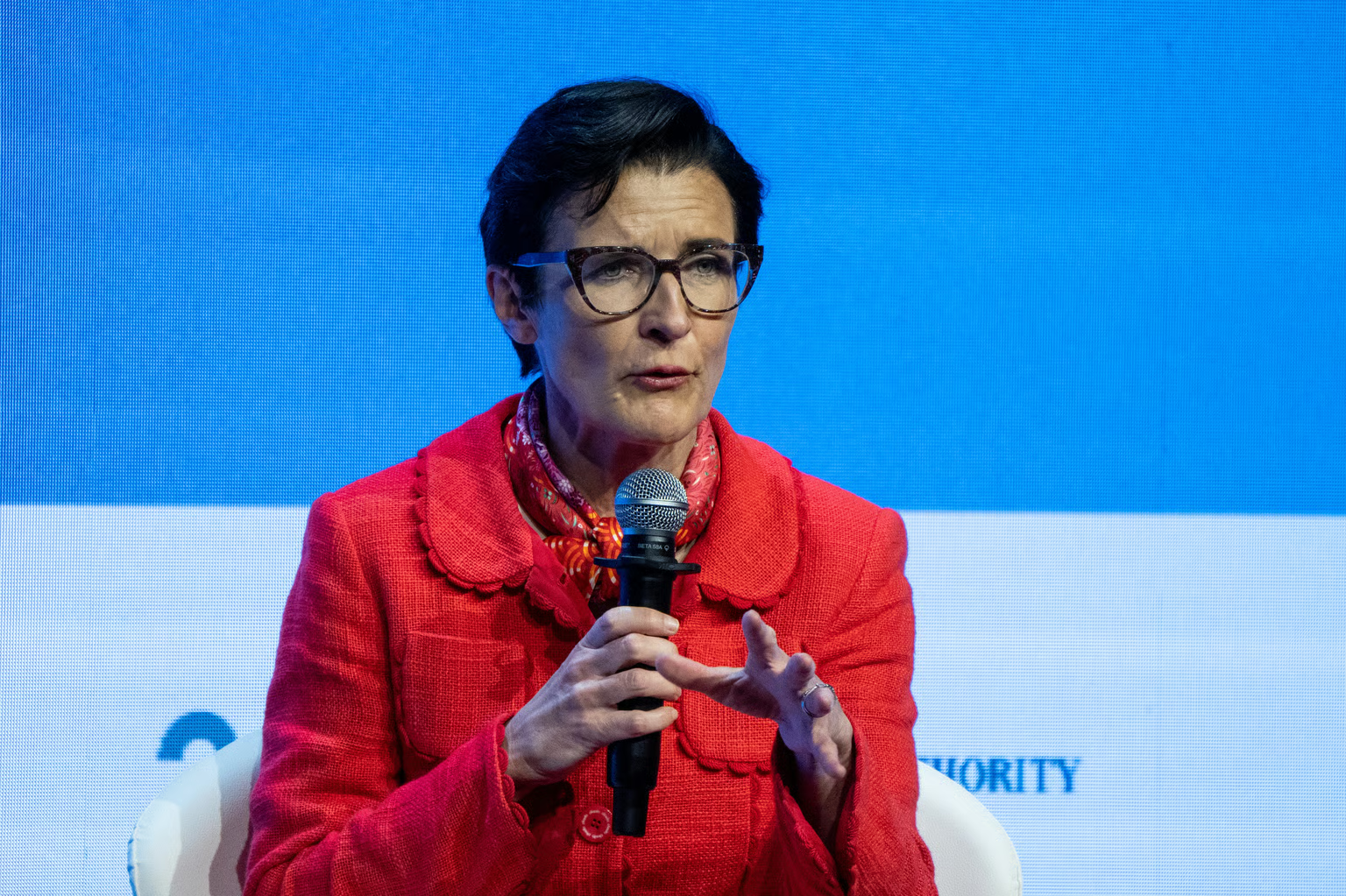
Four years after promising to transform Citi, Jane Fraser returned to the bank’s investor day. The first question was whether its culture remained the same.
The first person to raise his hand was Mike Mayo, an analyst at Wells Fargo. He said that for fifty years Citi’s culture had been reckless, arrogant and complacent, and asked how long it takes to change a culture.
Fraser told him he looked very elegant and thanked him for wearing Citi blue. Only then did she answer. When the analyst finished distributing questions among her executives, she stopped him with a smile and pointed out that he had managed to fit seven questions into one.
Part-time
Jane Fraser was born in 1967 in St Andrews, Scotland. At the age of twelve, she moved with her family to Australia. She wanted to become a doctor but ended up studying economics at Cambridge.
From there she joined Goldman Sachs, working in mergers and acquisitions in London. In 1990, she moved to Madrid to work at a brokerage firm and learned Spanish, a seemingly minor detail that ended up shaping much of her career. She later earned an MBA from Harvard.
She joined McKinsey and, after the birth of her children, worked part-time for five years. Even so, the firm promoted her to partner.
Fraser did not join Citi until 2004, at the age of 37, as head of client strategy in investment banking. Inside the bank, she followed a long path: she transformed the private bank, led operations in Latin America and eventually took charge of the entire global consumer banking division.
In 2019, she was appointed president, and in March 2021 she became CEO, the first woman to lead a major Wall Street bank.
One phrase defines her management.
It is not a destination. It is a waypoint.
She used it to describe this year’s return target, set between 10% and 11%, and repeated it a few days later in India.
What comes next is divided into two stages. First, she is aiming for a return of between 11% and 13% in 2027 and 2028, close to the top of that range. Then, she wants to reach between 14% and 15% in the medium term, once the dismantling of what remains of the old bank is complete.
She reorganized Citi into five businesses, withdrew from consumer banking in several countries, reduced the structure, changed the leadership team and tied part of executive compensation to results.
The first quarter produced the highest revenue in a decade and growth across all five businesses, following a record year for revenue and the return of US$17.6 billion to shareholders. That day, she also announced that Citi would allocate US$30 billion to share buybacks.
Regarding the consent orders, the regulatory directives still weighing on the bank, she said that 90% of the programs were already at or near the expected level. What remains is concentrated in data and depends on the regulators.
The power of focus
In India, she was asked whether markets had entered a period of irrational exuberance. Fraser replied that they were a little optimistic and clarified that she was using a British euphemism.
She explained that there is a large amount of money looking for opportunities, fear of missing out and excessive confidence that everything will turn out well.
She immediately placed a limit on her own warning. Nobody knows when a correction might occur, and those who predicted two years ago that something was about to break were wrong.
She does not, however, believe that investment in artificial intelligence is excessive.
On cybersecurity, she rejected the idea that only companies with access to the most advanced models can defend themselves. She said vulnerabilities are shared and corrected for everyone, meaning that it is not a zero-sum game.
Citi sold its consumer banking operation in India and in thirteen other countries, completing the Indian transaction in the Northern Hemisphere summer of 2023.
According to the figures Fraser provided, net income grew by 35%, revenue by 30% and the balance sheet by 25%. She said Citi remains the most profitable foreign bank in India.
For Fraser, the explanation lies in focus. Citi concentrated the franchise on clients with cross-border needs and stopped trying to cover everything.
When asked which of all the changes had produced the greatest result, she refused to choose one. She said Citi had moved from operating as a holding company to genuinely managing its businesses from the center, with standards applied consistently.
It was the combination of all those changes that increased the speed of execution. She added, without affectation, that she wished it had been only one thing, because that would have been much easier.
She spoke about India with restraint. She met with Prime Minister Narendra Modi for almost an hour and highlighted his approach to energy security.
She recommended that investors think in the long term, although she warned that valuations are higher than in other markets and that private and foreign investment remains weak.
What remains
The most uncomfortable question came from the audience.
An analyst from Evercore made the calculation that nobody had stated aloud: even if Citi delivers everything it has promised, it would still remain a couple of percentage points below the targets announced by its largest competitors.
Fraser did not deny it. She said everyone at the table believes there is still further to go.
She asked to be allowed to focus first on the 11% to 13% range, adding that the 14% to 15% target would be discussed later.
It is the same logic she used to reject the suggestion that she was deliberately setting modest targets in order to outperform them.
She said the first quarter is always the strongest of the year and that one quarter does not make a full year. Citi will deliver what it promised, but it will not cut off its nose to spite its face. The bank will not reach a number by sacrificing the investments that sustain growth.
Citi already sacrificed the long term for the short term once, and it will not happen again.
Fraser closed the event by recalling that four years earlier she had promised to transform the bank and that the results could now be seen. She said the team was ready to compete, that the days when simply performing adequately was enough were over, and that the holding-company mentality and diffuse accountability had been left behind.
What she did not explain was how much remains to be done.
A waypoint, by definition, is not a place where one stops. But it is also the only formula that allows someone to promise a destination without setting a date.