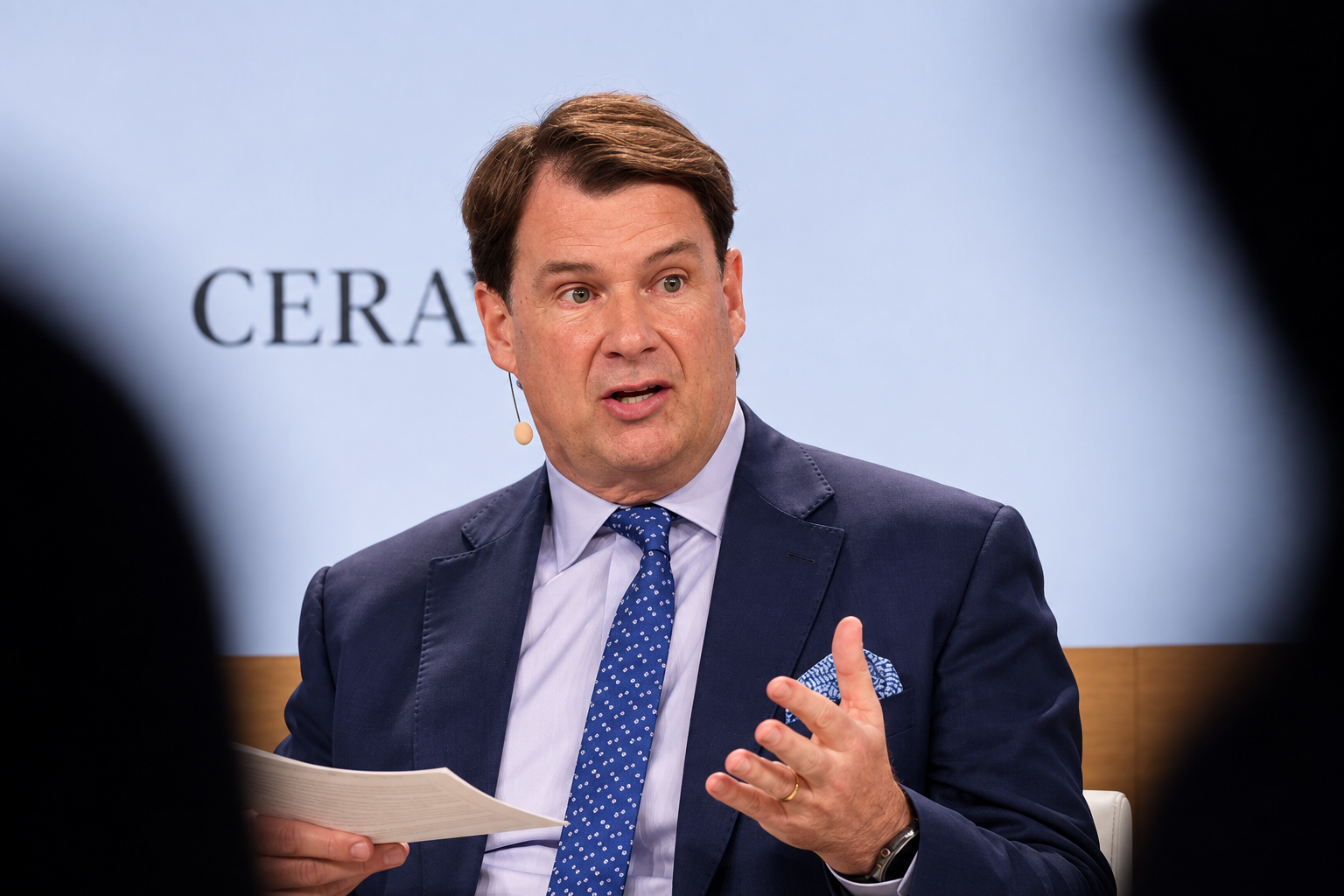
At Toyota, he learned a Japanese rule that requires people to see problems with their own eyes before making a decision. He applied it by tearing down Chinese cars and discovered that Ford, the company that invented mass production, was twenty-five years behind.
In Toyota terminology, it is called genchi genbutsu, and inside factories it is often shortened to gemba. It means go and see. Do not read the report or look at the presentation: go down to the factory floor, touch the part and ask the engineer why it is there. Jim Farley learned it during his years at the Japanese automaker, before returning to Ford, and since then he has not made a major decision without seeing things in person. Others treat it as a problem-solving technique. He describes it almost as a matter of using all five senses.
The biggest decision of his career began that way, in front of a cable. Ford tore down a Tesla Model Y and a BYD to compare them with its own electric vehicle, the Mustang Mach-E. The Mach-E’s wiring harness was beautiful, he admits, but it weighed around 32 kilograms more than Tesla’s and contained more than a kilometer and a half of extra cable. Carrying that weight added roughly $200 in battery cost to every vehicle. Then he counted the fasteners: the Model Y used one-third as many as the Ford. The BYD had around 30% fewer parts.
For the customer, he admits, the difference is invisible. For him, it was an X-ray. The number of fasteners, he argues, is a measure of how elegant an engineering solution really is.
A Badge That Could Not Open the Door
Farley, who has led Ford since 2020, then asked himself an uncomfortable question: could his team beat BYD? He took the question to Bill Ford, the founder’s great-grandson and chairman of the board, and to his own team. His answer was that he loved them, but did not believe they could.
The conversation that finally convinced him was with Doug Field, chief engineer of the Tesla Model 3, a veteran of Apple’s car project and, much earlier, a designer of the Segway. Field told him that Ford’s systems for releasing parts, its computing architecture and its design tools were twenty-five years behind. With that, they were not going to beat anyone.
That led to the creation of a separate group in Irvine, California. Its leader could bring in people from Ford, but could also reject anyone. They worked quietly for three years, and even the CEO’s own badge could not open the building’s door. Farley told his established team not to waste their time: if they wanted to get angry, they could go yell at him in his office.
It was not a popular decision. After a century of perfecting the combustion engine, and after surviving the 2008 crisis without going bankrupt like some of its rivals, Ford had, in his view, developed too much confidence: the belief that it could beat Tesla simply by being Ford. Telling a team that it did not have the right to build the company’s next product was one of the hardest things he had to do.
The result is the Universal EV Platform. Its first vehicle, scheduled for 2027, will be an affordable pickup that starts with one color, one version and one specification, adding complexity only once the basics work. Farley himself has warned that there are no guarantees: no one has previously built a vehicle in three pieces, using two large high-quality castings, at that price.
The Picture in the Locker
His other gemba involved China. In 2024, he asked his team to select the five best Chinese electric vehicles and bring them to Michigan. The one that impressed him most was Xiaomi’s SU7, made by a company he calls the Apple of China. The car recognizes the driver’s face, does not require the phone to be paired, carries the owner’s digital life inside it and accelerates like a Porsche Taycan, for around $30,000. He drove it for months between his home and the office and showed it to his peers in Dearborn. He described it as one of the most humbling experiences of his life.
He says he keeps a picture of that car in his metaphorical locker and looks at it every morning. And he repeats a historical calculation: Ford missed Japan, missed South Korea and cannot afford to miss China. If the CEO respects Chinese competition, he argues, the entire company has to do the same.
The Factory Worker’s Grandson
There is another picture in the CEO’s office: his grandfather’s Ford employee badge. His grandfather joined Ford’s assembly line at the age of fourteen. He was an orphan, arrived with nothing, never went to college and eventually became a Ford dealer after the age of sixty. That job paid for his mother’s university education, and his mother paid for his. Farley says he can still hear his grandfather telling him to stop talking and get back to work.
That is why he keeps emphasizing what he calls the essential economy: plumbers, electricians, technicians, firefighters and factory workers. The United States is short around half a million construction workers and another half million factory workers. Ford dealerships alone have 8,000 unfilled technician jobs, some paying around $120,000 a year. While artificial intelligence multiplies office productivity, he says, nobody is doing the same for people who work with their hands.
He practices that idea at home. His 17-year-old son Jameson, raised on video games and Minecraft, spent a summer learning how to weld. Farley is not a good welder, but his son is. On weekends they work together on his father’s 1973 Bronco, and the son tries to do things differently and better. If he ends up becoming a welder or a diesel mechanic, Farley says, he would be happy.
Go and See
As a child, he was nicknamed Jimmy Car Car. He drove from Los Angeles to Michigan before he had a driver’s license, races cars on weekends and every year takes vehicles on long road tests. His next test will cover around 2,000 miles across Australia, comparing the Ranger with Chinese pickups such as the BYD Shark and Great Wall models. It is the same Ranger that Ford manufactures in General Pacheco, at the plant he recently visited. He chose Australia because all the brands compete there without tariffs.
The bet has not come without a cost. After announcing the platform, Ford recorded a $19.5 billion accounting loss in its electric vehicle business, discontinued the F-150 Lightning and lost Doug Field. In Europe, the criticism is different. Farley admitted that the Fiesta and Focus could not compete on cost with Toyota, Hyundai and Kia, and critics accuse him of retreating into the Mustang, Bronco and pickups while relying on partners such as Renault for mass-market cars.
If he could invite anyone onto his podcast, he would choose Henry Ford. He has read the founder’s notebooks in the company archive, where a shopping list for two dozen eggs sits alongside a drawing of a steering box, and he would like to ask him for advice. The founder would probably tell him the same thing his grandfather did and the same thing Toyota taught him: go and see.