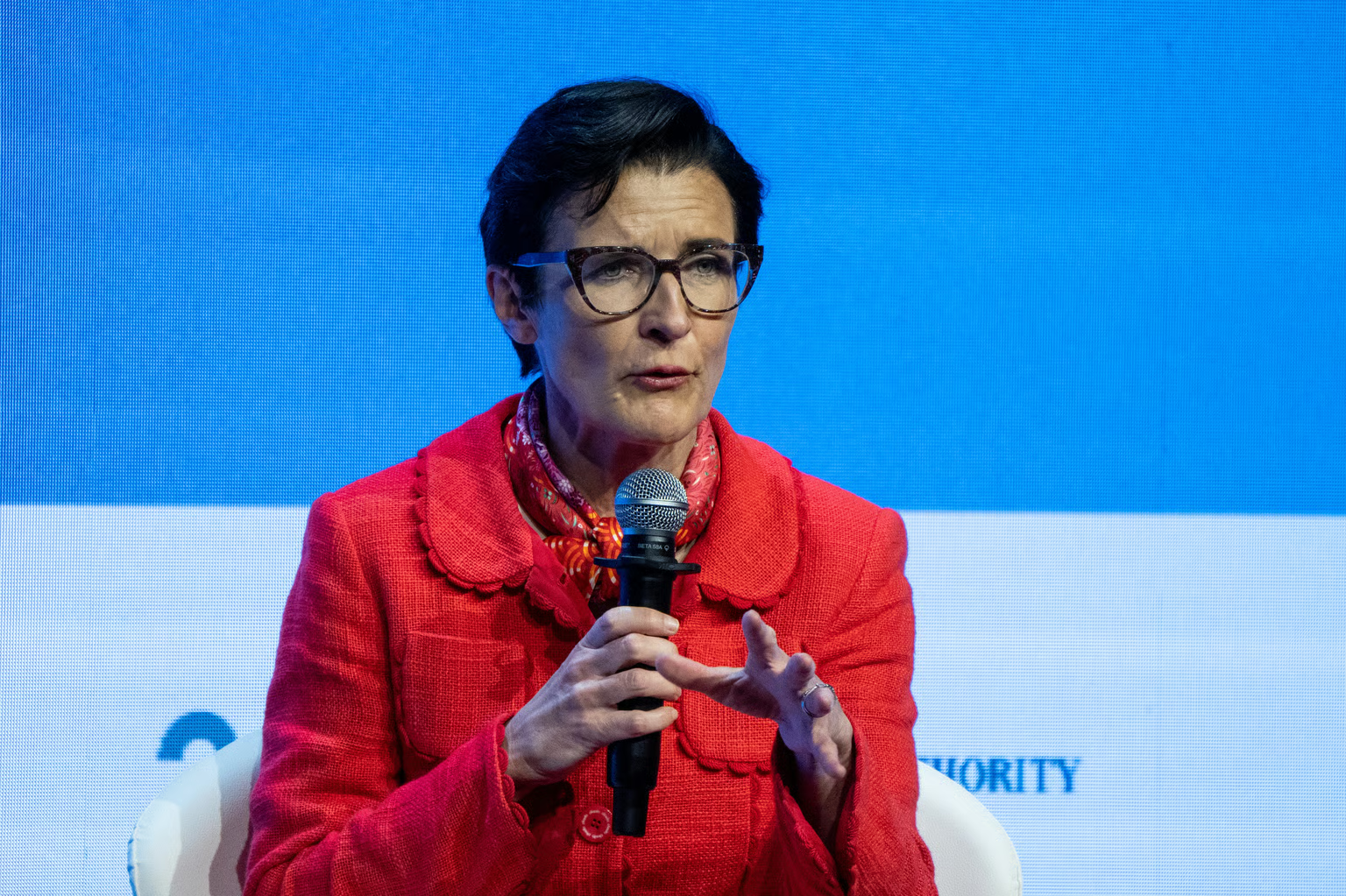
On Sunday, October 26, 2025, Argentina was holding legislative elections, and not much was happening at Ripio. Sebastián Serrano remembers it in a much more graphic way: “Tumbleweeds were rolling.”
A few weeks earlier, they had tokenized AL30, the country’s most heavily traded sovereign bond. That meant it could continue to be bought and sold on the blockchain even when the stock market was closed. Election Sunday was a good opportunity to find out whether this had any concrete use or was merely a technical possibility.
For much of the afternoon, it seemed that the answer would be the latter. It was only around six o’clock, when the first results began to emerge, that things started moving. AL30 began trading heavily and reached Monday with a price already formed before the traditional market opened.
Until then, during an election weekend, anyone who wanted to follow the mood of the financial markets had practically only one real-time reference: the crypto dollar. That night, another one appeared. An Argentine bond was trading on a Sunday.
That is where much of what Ripio is doing now comes in. The company was founded in 2013 around Bitcoin, but over the years it added bonds, local currencies, credit and technology for other companies. Today, it says it reaches more than 24 million users across eight countries.
Serrano was there through almost the entire evolution of crypto as an industry. He saw Bitcoin reach prices that once seemed impossible and then lose much of its value, huge companies disappear in a matter of days, and international competitors arrive in Latin America with plans that, once on the ground, proved considerably more difficult to execute.
Now he believes another crypto winter is approaching. He has already been through four and, precisely because he has seen them up close, he thinks this one will not necessarily unfold in the same way.
Choele Choel
Long before Bitcoin, there was Choele Choel.
Serrano grew up in that city in Río Negro, where his parents had bought a small farm. When he was eight, he found a computer magazine and became fascinated by the subject. He kept insisting at home until they finally got a computer.
Years later, he took part in setting up the city’s first internet provider. Then he moved to La Plata to study Physics. He completed three years, realized he wanted to go in a different direction and switched to Systems Analysis.
In 2007, he started a software development company. They began working from Argentina and eventually landed projects for Silicon Valley startups. That connection ultimately led him to live in the United States as well.
He began paying attention to Bitcoin in 2012. It was still far from being an everyday topic at banks, investment funds or financial media outlets. Outside certain technology-related circles, it remained something fairly strange.
A year later, he founded the company that would eventually be called Ripio.
The name came from the roads of Patagonia. Ripio is the gravel that makes a road passable when it would otherwise be difficult to travel. The image worked well to explain what they wanted to do: make it easier to access a technology that, at the time, was far from simple for most people.
Back then, it was Bitcoin. Over the years came bonds, credit and local currencies. The business expanded considerably, although that original idea remained.
A different cycle
In this latest cycle, there was something Serrano expected that never appeared with the same intensity as in previous ones.
Euphoria.
Bitcoin reached new highs again, ETFs arrived, regulation advanced in the United States and major funds began buying steadily. A few years earlier, any one of those developments would have seemed extraordinary.
What did not appear in the same way was a massive influx of small investors.
In previous cycles, there came a point when many people bought simply because they were afraid of being left out. A feeling took hold that any crypto-related asset could keep rising and nobody wanted to arrive too late.
Serrano expected something similar to happen this time. It did not, at least not with the same intensity.
For him, there was another, much more important moment: October 10. That day saw an enormous liquidation of leveraged positions that, according to his calculations, was about five times larger than the one that occurred during the collapse of FTX. Many traders were pushed out of the market in a very short period of time.
That also changes the way he thinks about a possible Bitcoin decline.
In previous major crypto winters, Bitcoin lost around 75% or 80% from its highs. If it repeated something similar from $120,000, it could fall close to $40,000.
Serrano does not believe that is the most likely scenario.
His argument is that this time there was no previous euphoria comparable to other cycles and that a significant amount of excessive leverage had already disappeared in October. He also saw something different around $100,000: investors who had held Bitcoin for years began selling to new buyers.
For him, there was a significant turnover among holders, not simply a rush of people buying at any price.
Ripio did not manage to anticipate the peak either. They did not sell when Bitcoin was at $120,000 because, Serrano admits, they did not see it in time. They began reducing positions at around $110,000 and continued doing so afterward.
Today, the company holds around 60% of its position in fiat currencies and 40% in crypto. Toward the end of the year, they plan to begin changing that balance again.
The first tokenized asset was far less exotic
For years, when people talked about tokenization, examples such as properties, works of art, farmland or expensive assets that could be divided into small stakes were often mentioned.
Large-scale adoption ended up arriving through something much more familiar: the dollar.
Serrano considers stablecoins to have been, in practice, the first major tokenized real-world asset.
He also sees an important difference with Bitcoin. Cryptocurrency prices can go through extremely sharp cycles, while the amount of digital dollars circulating on blockchain has been growing in a much more consistent way.
That also led him to reconsider an idea that was repeated for years within the industry: that an asset necessarily becomes better when it is tokenized.
Not always.
“If something is illiquid, it is probably illiquid for a reason,” he says.
That is why Ripio chose to start with AL30. It was an asset that already had a great deal of liquidity and trading volume before moving onto blockchain; there was no need to invent a market for it. They are now working on five other Argentine assets.
The next step is considerably less intuitive: they want to tokenize six Latin American currencies, including the Argentine peso, the Brazilian real, the Colombian peso and the Peruvian sol.
And in a country where much of the interest in crypto arose precisely from the desire to move away from the peso, the idea requires some explanation.
What a digital peso could be used for
Serrano does not dispute that a significant part of Argentina’s crypto adoption was linked to the search for an alternative to the peso.
But when he talks about tokenizing local currencies, saving is not the first thing he has in mind. He thinks about using them.
Today, someone can deposit one thousand reais into a wallet and, after conversions and fees, end up with 950 units of another asset whose workings they may not even understand. With a stablecoin denominated in reais, they put in one thousand and receive one thousand digital reais.
For someone who has never used crypto, it is much easier to understand what is happening.
What interests him most, however, is what could happen with credit.
A person who earns in pesos and takes on debt in dollars adds an obvious risk: if the exchange rate changes, the debt can grow while their income remains denominated in the same currency.
Many crypto protocols currently operate with a similar logic. The user puts up Bitcoin or another asset as collateral and receives a loan in dollars.
Serrano believes it could work differently: use Bitcoin as collateral, but borrow pesos, reais or soles. The debt would be denominated in the same currency in which that person earns their income.
Many pieces are still missing before that can work on a broader scale. Unsecured loans, scoring systems, mechanisms that make it possible to build a reliable financial history on blockchain.
Tokenized local currencies do not solve all of that. For Serrano, they simply address one part of the problem that until now has been poorly served.
“This is not Instagram”
Over these years, Ripio has also seen international competitors with vastly greater amounts of capital arrive in Latin America.
Some left. Others are still there, although with plans quite different from the ones they had when they first arrived.
Serrano often explains the problem with one phrase: “This is not Instagram.”
A social network can launch in a new country and operate almost exactly as it did in the previous one. On a financial platform, things are considerably less simple.
There are different banks, different regulations, licenses, particular ways of moving money and habits that change from one market to another. Translating the app, by comparison, is the easy part.
Ripio maintains teams and licenses in the countries where it operates. It could add more markets, Serrano says, but he sees little point in doing so merely to increase the number of countries listed in a corporate presentation.
For a long time, particularly among technology companies, geographic expansion seemed like automatic proof of growth.
In finance, it does not necessarily work that way. Every new country also brings a new list of problems and, if you only start understanding them after entering the market, you will probably end up paying quite dearly for that learning process.
One million dollars
There is one prediction Serrano continues to stand by: Bitcoin could reach one million dollars before the end of the decade.
When he develops the argument, however, Bitcoin takes quite a while to appear.
His starting point is that many risk assets are expensive and that, at some point, a sharp correction could occur. Faced with a significant decline in economic activity, he expects a familiar response: lower interest rates, more liquidity and governments trying to prevent the economy from slowing too much.
Some of that money typically ends up flowing back into financial assets.
Up to that point, the story is familiar. What Serrano believes could alter the next cycle is artificial intelligence.
In previous recoveries, when cheap money returned, many companies resumed projects, invested and hired. Now a company can invest enormous amounts of money and direct much of it toward data centers, software, automation or robots.
That opens up a different possibility: investment could return without employment recovering in the same proportion.
Serrano does not know whether that will happen. Nor does he try to assign it a probability.
What he asks himself is what governments would do if capital starts flowing back into the economy, companies begin investing again and, even so, a large share of jobs do not return.
One possible response would be new stimulus measures and even more liquidity.
If that scenario were to occur, he says, it would also change his calculation for Bitcoin.
In that context, one million dollars would no longer necessarily seem like a ceiling.