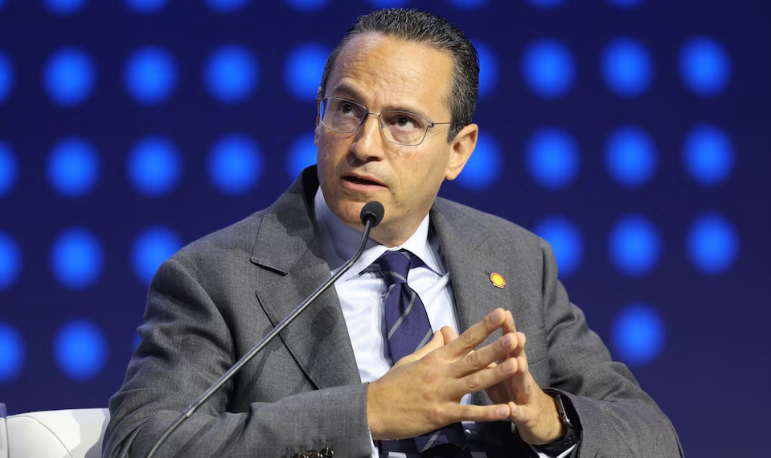
Wael Sawan is the current chief executive officer (CEO) of Shell, one of the most important oil companies in the world. Of Lebanese origin, the engineer joined the company more than 25 years ago and built a rising career. After 2023, when he was appointed chief executive officer, Sawan consolidated himself as one of the most influential people in the energy sector.
How did his career develop? He was born in Beirut in 1974 and spent part of his youth in the Middle East before moving to the United Kingdom to pursue higher education. He graduated as a chemical engineer from the University of Manchester and, shortly after completing his studies, joined Shell in 1997, a decision that marked his professional career.
Sawan’s rise within Shell
Many chief executive officers who today lead major energy companies followed a long path before becoming the public face of the company. Like many others, Sawan is no exception and spent more than twenty years at the British company before becoming CEO. He worked on projects related to conventional oil, natural gas and integrated operations, and developed a broad understanding of the international energy business.
In 2023, he was appointed chief executive officer of Shell, replacing Ben van Beurden. His appointment was interpreted as a sign of continuity in the commitment to natural gas and to a more gradual energy transition than the one proposed by some political and environmental sectors.
What has he done in recent years with Shell? He promoted a strategy centered on financial discipline, profitability and energy security. Although Shell still develops sustainable projects aimed at reducing emissions, the new CEO made it clear that the company would not quickly abandon its traditional oil and gas businesses.
He implemented operational efficiency programs, reviewed investments considered less profitable and concentrated resources in strategic areas such as liquefied natural gas, offshore production and petrochemicals. Why did he do all this? In order to strengthen Shell’s image against the competition. Along these lines, the Lebanese executive reinforced the role of LNG.
What is Sawan’s view of the future of the energy industry?
Sawan’s influence has been incredibly beneficial for Shell’s financial results. His leadership reflects a current of thought that is increasingly present within the energy industry. What is it based on? On the idea of a transition toward a lower-emission economy that must be built without compromising global energy security.
Along these lines, and in pursuit of a safer and more profitable economic transition, Shell spent a large amount of money in the first quarter of 2026. What happened? Under Sawan’s authorization, the British multinational acquired ARC Resources, a transaction valued at approximately 16.4 billion dollars, and it became Shell’s largest purchase since the acquisition of BG Group a decade earlier.
Shell and Sawan’s million-dollar move
The purchase does not represent an increase in production. The acquisition has a direct connection with one of the company’s most important strategic projects: LNG Canada, where Shell holds a 40% stake. The gas produced by ARC feeds future expansions of liquefied natural gas exports to Asian markets, clearly an international expansion strategy with greater reach.
It should be noted that Shell has assets in Vaca Muerta, and along these lines there remains the chance to increase production levels by 4% annually. For greater clarity, the CEO stated that “ARC is a high-quality, low-cost producer with low carbon intensity operating in the Montney basin. This acquisition complements our current presence in Canada and strengthens our resource base for the coming decades.”
Wael even considered Canada a central market for the energy industry. Unlike the competition with companies from the United States, the Lebanese engineer confirms the North American country as an important ally in energy projects.
Sawan considers Canada to occupy a privileged position on the global energy map. The country has some of the largest hydrocarbon reserves in the world, developed infrastructure and a geographic location that allows it to connect with Asian markets through the Pacific coast. While he did not make this pact with the United States, he looks favorably on the neighboring country on the same continent, given characteristics that acquire special importance in an international context where energy security has become a priority for governments and companies.
The acquisition of ARC Resources in 2026 further reinforced that commitment. From Sawan’s perspective, incorporating Canadian gas reserves not only increases Shell’s production, but also guarantees supply for future expansions of the LNG business. The operation consolidated Canada as a strategic platform for the company’s growth over the coming decades. And above all, as an ally for the future.