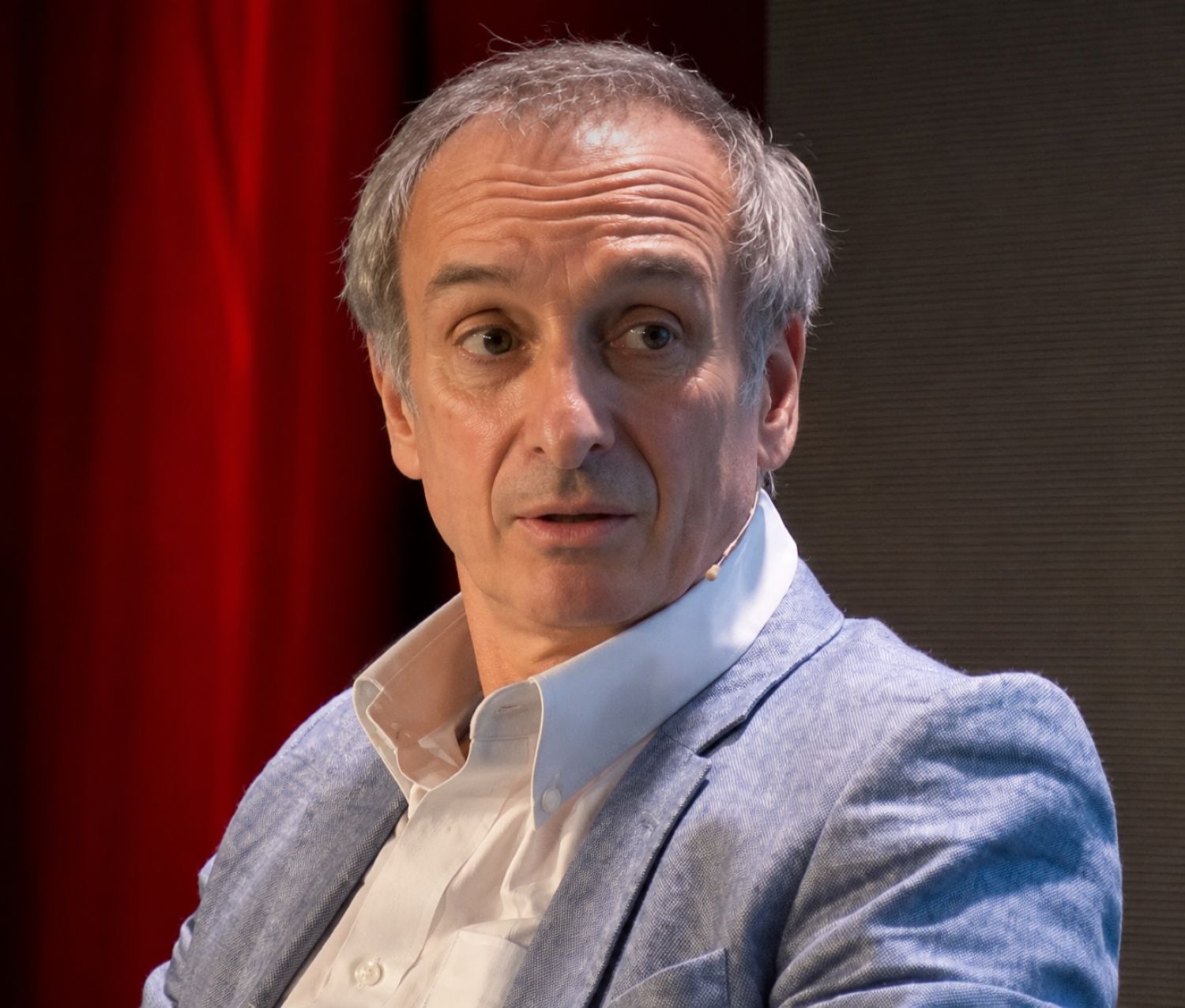
With the election just around the corner and a new administration on the horizon, energy-sector CEOs met in September 2019 to make clear what they expected from the incoming government. The next speaker was Daniel González, then at the helm of YPF. He gave a direct answer that carries a meaning today that is difficult to ignore.
He said investment required an appropriate and stable legal framework, without unilateral interruptions. That the economic situation was difficult. That fuel prices were lagging by 20% and the inability to adjust them had forced the company to cut operations. He also warned that delays in infrastructure could eventually hold back opportunities that had already been identified.
It was a list addressed to a government that did not yet exist.
Seven years later, he is the person responsible for fulfilling it.
Daniel González Casartelli attended Cardenal Newman, the same school as Luis Caputo, the minister to whom he now reports, and holds a degree in Business Administration from the Argentine Catholic University. He is not a geologist. He is not a petroleum engineer. He has never drilled a well. Since July 2024, he has coordinated the Energy and Mining areas and chaired the committee that evaluates projects submitted under the investment incentive regime.
The deal that marked a turning point
In the early 1990s, González joined the finance team at Transportadora de Gas del Sur, at a time when Argentine companies were beginning to raise funds abroad.
His work behind those placements did not go unnoticed. Reca recruited him to work at Merrill Lynch.
He stayed for fifteen years, until the bank was absorbed by Bank of America. The job consists of standing before a committee in New York and explaining why an Argentine asset is worth what its owners claim. It is a profession built on translation.
May 2012
In April of that year, the State expropriated 51% of YPF. González joined as CFO in May.
The chronology helps explain what happened. With Galuccio newly installed at the head of YPF, the company was looking for a financial executive with enough authority to reassure investors and creditors. González was recruited through an executive search firm.
Translated into plain terms, the assignment was to convince international markets to lend money to a company whose controlling stake had just been taken from its shareholders by the State.
He did it.
He spent six years as CFO. In April 2018, following Ricardo Darré’s unsuccessful tenure, the board confirmed him as CEO. In October, he presented the plan to investors in New York: to invest between 4 and 5 billion dollars annually and prepare the company for the expansion that would come with shale production. The shares rose by 4%.
In April 2020, he was removed by decision of the shareholders.
The challenge of making it happen
His entire reasoning is organised around a single idea: less discussion about what should be done and more about how to do it.
He applies that principle to offshore exploration, where his argument is that Norway does not live badly either. He also applied it to glaciers. It is not an environmental position, but a framework for negotiation: shifting the conversation from prohibition to the conditions under which an activity can proceed.
The second move consists of changing the scale of the analysis. When explaining the scope of the law, he distinguishes between the large, well-known glaciers and rock glaciers located at an altitude of four thousand metres. The method is to leave generalisations aside and concentrate on the specific facts that can be verified.
There is also something he repeats: this does not begin with the company or the money, but with the resource.
It is said by a man who entered the industry from an investment bank.
What he does not include
In September 2024, during his first public appearance in the role, he compared copper with Vaca Muerta ten years earlier. There was no glacier law. There was no approved copper project. Today, copper leads the portfolio.
The real potential may lie in the projects he has not yet included: offshore exploration, Palermo Aike, D-129 and uranium development. The resources and opportunities are there, but González makes clear that they are not yet part of his calculations. The figures he presents are based on defined projects, with companies in charge and investment decisions already confirmed.
A CFO does not include in the model what has no owner.
The meeting point
In November 2025, he was responsible for opening the bids in the tender for the four Comahue hydroelectric plants. Piedra del Águila was awarded to Central Puerto, the company through which Guillermo Reca—the man who had taken him to Wall Street thirty years earlier—eventually became one of the leading players in Argentina’s electricity business.
The Argentine energy world is smaller than it appears.
González’s role has changed. He once presented projects; now he also takes part in the decisions that make them possible. Today, he coordinates Energy and Mining, participates in the evaluation of RIGI projects and helps determine the destination of investments in oil, gas, electricity, copper and infrastructure. In April 2026, he estimated that energy and mining could together contribute around 60 billion dollars to the trade balance within five years.
In 2019, González outlined the conditions required for capital to reach a country. It was not a complaint, but a list of requirements, which is how a banker explains what is needed before signing.
Now he has to sign from the other side.