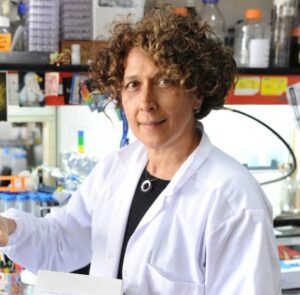
In March 2020, Andrea Gamarnik and her team at Fundación Instituto Leloir began working on a test to detect antibodies against the coronavirus. Within 45 days, they developed COVIDAR IgG, the first serological test designed and manufactured in Argentina. Produced at scale, it allowed hospitals and laboratories across the country to study the immune response to the virus using a locally manufactured test.
Until then, much of Gamarnik’s research had focused on dengue. From the laboratory she established after returning from the United States, the virologist and CONICET researcher studies how the virus replicates and how it manages to infect both mosquitoes and people.
From Lanús to California and back to Buenos Aires
Gamarnik was born in Buenos Aires on October 5, 1964, and grew up in Lanús. She studied biochemistry at the University of Buenos Aires, graduating in 1988 with a gold medal for academic achievement. In 1993, she completed her doctorate at the same university.
The following year, she moved to San Francisco to study poliovirus at the University of California. She conducted her postdoctoral research there between 1994 and 1999. She then spent two years at ViroLogic, a biotechnology company, developing tests for HIV and hepatitis. Working in industry gave her experience beyond university research: the goal was to develop tests that laboratories could use.
In late 2001, during Argentina’s economic crisis, she returned home. She joined Fundación Instituto Leloir and established its first molecular virology laboratory. Between 2005 and 2011, she was an International Research Scholar of the Howard Hughes Medical Institute, conducting her research from Buenos Aires.
How the dengue virus replicates
One of the laboratory’s first questions concerned how the dengue virus copies its genetic material inside a cell. Gamarnik’s team studied that process and, in 2015, published findings that helped explain how the virus adapts to two different hosts. Throughout its transmission cycle, it moves from a mosquito to a person and back to a mosquito. It encounters different cells in each host and must be able to replicate in both.
The group also studied viral attenuation: reducing a virus’s ability to cause disease. That research contributed to vaccine design and led to technology that was transferred to the United States.
When the pandemic began, the team faced a different need. Laboratories required a test to determine whether a blood sample contained antibodies against the coronavirus. Gamarnik and her colleagues could draw on their experience in virology and assay development. COVIDAR IgG made that expertise available to hospitals and laboratories across Argentina.
Recognition in Argentina and abroad
In 2016, Gamarnik received the international L’Oréal-UNESCO For Women in Science Award as the representative for Latin America. Five years later, she was elected to the American Academy of Arts and Sciences. She was also the first Argentine woman admitted to the American Academy of Microbiology.
In December 2022, she received Argentina’s National Researcher distinction, followed by a Platinum Konex Award in 2023. Alongside running her laboratory, she helps evaluate other researchers’ work as an associate editor of PLOS Pathogens and a member of the editorial board of Virology.
The work that begins before an emergency
Gamarnik advocates sustained funding for basic research and takes part in discussions about women’s place in science. Her career shows what it means to maintain a research group over many years. Nearly two decades passed between her return to Argentina and the development of COVIDAR IgG. During that time, her team studied how viruses replicate, trained researchers, and gained experience developing tests.
The 45 days associated with COVIDAR measure the time it took to develop the test. The ability to do it that quickly had been built since 2001, when Gamarnik returned to Buenos Aires and began setting up her laboratory.