

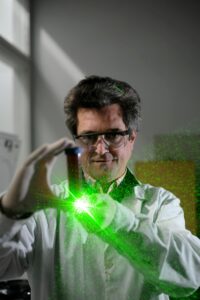
Galo Soler Illia studies materials with pores so small they are measured in nanometers. Divide a millimeter into a million equal parts, and each one measures a nanometer. At that scale, changing the size of a pore can make a material retain certain molecules while letting others pass through. These are the kinds of problems the Argentine chemist investigates in the laboratory and explains beyond it, on television, in his books, and in public talks.
A senior researcher at CONICET and founding dean of the Institute of Nanosystems at the National University of San Martín (UNSAM), Soler Illia spent part of his career in France. After returning to Argentina, he established a research group at the National Atomic Energy Commission (CNEA). Years later, in San Martín, he brought together specialists from different disciplines to explore what these materials could do beyond the laboratory.
From UBA to Paris and back to Buenos Aires
Soler Illia was born in Buenos Aires in 1970 and attended the Colegio Nacional de Buenos Aires. He studied chemistry at the University of Buenos Aires and earned his doctorate in 1998 under the supervision of Miguel Ángel Blesa. His thesis examined how metal oxide particles form in a solution.
He then moved to Paris to work in Clément Sanchez’s laboratory, where he specialized in mesoporous materials. There, he moved from studying how particles form to investigating how to make solids with pores of a specific size. One question concerned the properties a material might have if researchers could control its structure from the outset.
In 2003, he returned to Argentina and established CNEA’s Nanomaterials Chemistry group. He trained doctoral students and continued his research there. He also held visiting professorships in Paris, Melbourne, and Osaka. His distinctions include Bernardo Houssay awards, the 2013 Platinum Konex Award in nanotechnology, and the National Academy of Sciences’ Ranwel Caputto Award.
What a material full of pores can do
One way to picture a mesoporous material is to think of a sponge. The comparison offers a starting point: even if a solid looks compact from the outside, it contains empty spaces. In the laboratory, researchers can adjust the size of those pores and modify their surfaces to interact with particular molecules.
That possibility interests researchers designing sensors, for example. If a material retains the substance they want to detect, it can help concentrate it and make it easier to measure. In medicine, another potential use involves placing a drug inside the pores and controlling its release. Self-cleaning coatings and glass that changes transparency are other examples of what researchers can pursue when designing materials at this scale.
Each application presents a different problem. A material that performs well in a laboratory test must still prove that it works under the conditions in which it will be used. Manufacturing it in larger quantities also means checking whether the process can be repeated without losing the properties that made it worth developing. Part of Soler Illia’s work with companies involves studying that step.
Building an institute and explaining its work
When he founded UNSAM’s Institute of Nanosystems, Soler Illia brought together chemists, physicists, biologists, and engineers. There is a practical reason for that combination. Developing a sensor, for instance, requires someone to make the material, another team to measure its response, and an understanding of the conditions in which it will operate. The institute follows that approach in projects related to health, energy, and the environment.
Alongside his research, Soler Illia began explaining these subjects to audiences who, for the most part, had never worked with nanomaterials. He was a contributor to Científicos Industria Argentina, gave talks at Tecnópolis, and published Nanotecnología. El desafío del siglo XXI through Eudeba. Talking about a sponge or glass that changes transparency allows him to start with something familiar and explain what chemistry contributes.
Outside science, his surname also recalls his grandfather, Arturo Umberto Illia, the physician who served as Argentina’s president until the 1966 coup. Galo Soler Illia built his own public career in research, student training, and science communication.
The work beyond the laboratory
When discussing Argentine science, Soler Illia often returns to two issues. One is the opportunity for young people to train and continue conducting research in the country. The other is how to organize work with a company when a development still needs testing, adjustments, and time before it can enter production.
His career illustrates both. What he learned in Paris about porous materials became part of the work of a CNEA research group and, later, an institute that trains new researchers. In San Martín, that work leads to practical questions. If a material can retain a molecule in the laboratory, will it still do so when other substances are present? Can it be manufactured in the same way in a larger batch? Much of the work lies between a promising result and a product someone can use.


