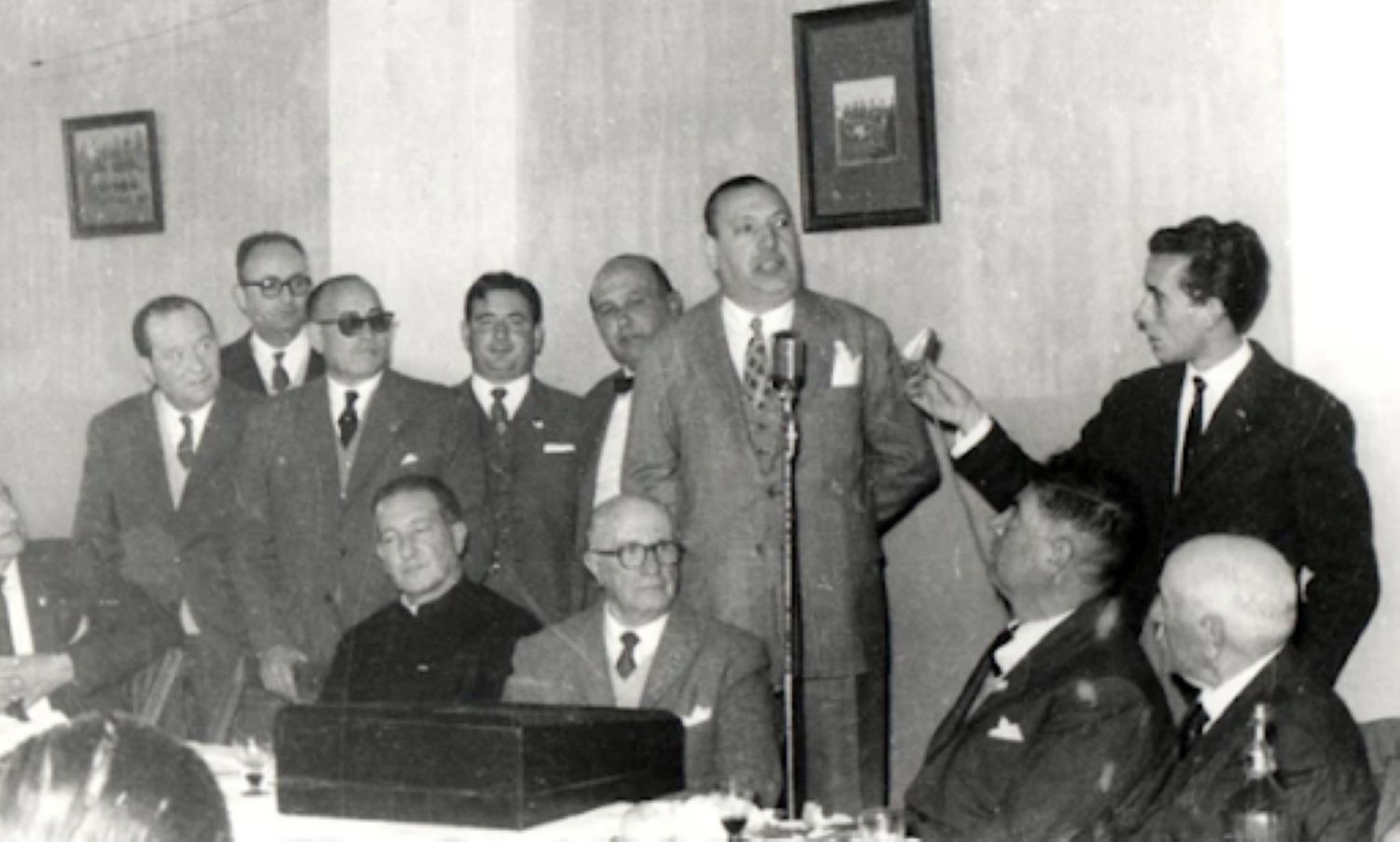
Raúl Colombo, born on December 2, 1907, and deceased on July 9, 1984, was a former president of the Argentine Football Association (AFA) between 1956 and 1965, a period during which he also served as president of the South American Football Confederation (CONMEBOL). He was additionally involved in politics as a national congressman.
Colombo also served as mayor of Pilar, a district in Buenos Aires Province, and as rector of the Mariano Moreno National College. Why was his tenure at the AFA so significant? He assumed office one year after the departure of former president Juan Domingo Perón and took control of a football association facing institutional crisis after several irregular and short-lived administrations.
How Did Colombo Reach the AFA?
Before leading the national governing body, Colombo served twice as president of Club Almagro, with his first term being the most consequential. During his presidency from 1936 to 1938, Almagro won the Second Division Championship in 1937, the fourth of the professional era and the first to grant promotion to the top tier of Argentine football.
In 1938, Club Almagro competed for the first time in the Argentine First Division Championship. The following year, after Colombo had stepped down, the club was relegated and returned to the second tier. In 1942, and until 1949, the sports executive returned to the club and assumed the presidency again, during a period of institutional transition and internal restructuring.
Colombo arrived at the AFA in 1956, one year after Perón’s removal from power. His appointment represented a shift toward institutional and professional order, placing administrative stability above sporting concerns. With experience at Almagro and following three brief and unstable presidencies at the association, the former politician was brought in to restore balance and governance.
One of Colombo’s defining characteristics was his consistent prioritization of institutional order over sporting performance. He was willing to sacrifice certain football-related objectives in order to impose a formal and bureaucratic management style. Publications such as El Gráfico described him as an “administrator” and a “negotiator.”
Administrative modernization was undoubtedly his greatest strength. How did he achieve it? Colombo understood that a successful presidency required reorganizing internal committees and revising rules and regulations. As a result, during his second year at the helm of the AFA, he established the relegation average system to determine demotions from the top division.
Relationship With the Argentine State
Between the 1950s and the 1970s, AFA presidents and leading club executives maintained direct relationships with successive national governments. The reason was clear: at the time, the Argentine state viewed football as a mass phenomenon and the association as a strategic institutional actor.
From the outset, Raúl Colombo sought to establish fluid communication between the government and the AFA in order to secure greater institutional backing for the association and for the country’s most popular clubs, particularly River Plate, Boca Juniors, Racing Club, and Independiente. These institutions carried greater political weight due to the prominence and influence of their presidents and senior executives.
The Argentine National Team Under Colombo’s Presidency
During Colombo’s tenure, the Argentine national team returned to World Cup competition. After the 1938 World Cup, the tournament was suspended due to the World Wars, and international football resumed in 1950. Argentina did not participate in the 1950 or 1954 editions because of internal institutional conflicts.
As a result, the national team returned to the World Cup in 1958, a tournament remembered for the so-called “Disaster of Sweden,” marked by a heavy 6–1 defeat to Czechoslovakia. Despite the poor sporting outcome and widespread criticism, Colombo’s presidency ensured Argentina’s return to the world’s most important international football competition.
Colombo stepped down from the AFA in 1965, shortly before the 1966 World Cup in England. His departure came during a period of renewed institutional difficulty, followed by the intervention of Valentín Suárez and subsequent state involvement promoted by the national government. This phase ultimately led to changes in competition formats and tournament structures.
During his time at the AFA, in addition to his presidency at CONMEBOL, Colombo served as a national congressman under the government of Arturo Frondizi, who governed Argentina between 1958 and 1962. Throughout the 1950s and 1960s, the former Almagro president held multiple responsibilities and remained active across several institutional fronts.
Raúl Colombo was not just another AFA president. With a serious, bureaucratic, and negotiation-driven style, he imposed institutional order during one of the most complex crises in the history of Argentine football governance, laying groundwork that would only stabilize fully years later.