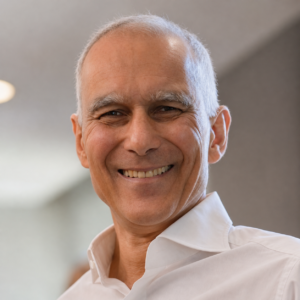
Moungi Bawendi scored 20 out of 100 on his first chemistry exam at Harvard. It was the lowest grade in the class and a surprise for someone who had gotten through high school science without much difficulty. When he received the Nobel Prize in Chemistry in 2023, he recalled that exam and explained what he had needed to change. Until then, he had never learned how to study.
The prize recognized work he did many years later. In 1993, Bawendi and two of his students found a way to make quantum dots with a size and quality that earlier methods had been unable to achieve. Quantum dots are tiny crystals made of semiconductor materials that can emit different colors of light depending on their size. Today they are used in displays, and researchers are exploring applications in energy and medicine.
He shared the Nobel Prize with Alexei Ekimov and Louis Brus, whose earlier discoveries had made it possible to study these particles. Bawendi’s contribution was finding a way to produce them under controlled conditions. Making use of their properties required crystals that were sufficiently uniform and a method that could reproduce the same result.
Learning how to study at Harvard
Bawendi was born in Paris on March 15, 1961. His father, Mohamed Salah Baouendi, was a Tunisian mathematician. The family lived in France and Tunisia before settling in the United States, where his father worked at Purdue University.
He finished high school in West Lafayette, Indiana, in 1978. Science came easily to him, and he was used to getting good grades without spending much time studying. At Harvard, that approach was no longer enough.
On his first chemistry exam, he found himself unsure how to manage his time or tackle the questions. Decades later, when he talked about scoring 20 out of 100, he explained that he had needed to learn how to study and take exams. The grade did not make him give up his studies.
He graduated from Harvard in 1982 and earned a master’s degree the following year. He then went to the University of Chicago, where he completed a doctorate in chemistry in 1988 under Karl Freed and Takeshi Oka.
He joined Bell Labs for his postdoctoral research. There he worked with Louis Brus, who was already studying quantum dots in liquid solutions. It was his first direct encounter with the subject that would occupy much of his career. In 1990, he moved to MIT to start his own research group.
The challenge of making uniform crystals
In the early 1980s, Ekimov had observed effects associated with the size of small particles embedded in colored glass. Brus later showed that the same effects occurred in particles suspended in a liquid.
When a semiconductor crystal is small enough, its properties change. In quantum dots, adjusting the size changes the color of the light they emit. For a given material, larger particles can emit toward the red end of the spectrum and smaller ones toward the blue.
That opened up possibilities, but there was a manufacturing problem. Existing methods produced mixtures of crystals of different sizes and with defects. It was difficult to study their properties precisely and even harder to obtain a material that could be used consistently.
At MIT, Bawendi worked on the problem with Christopher Murray and David Norris. In 1993, they published a method that gave them much greater control over how the crystals formed and grew.
The method involved injecting the compounds into a very hot liquid. The injection caused small nuclei to form and the temperature to drop, which helped stop new nuclei from forming. By adjusting the conditions afterward, they could make the crystals grow more uniformly.
Temperature, timing, and the preparation of the ingredients were crucial. Changing those conditions allowed the researchers to obtain particles of different sizes. The method, known as hot injection, became a benchmark for quantum dot synthesis.
The paper was authored by Bawendi and his two students. Murray and Norris went on to pursue their own research careers in nanomaterials.
Quantum dots make their way into displays
Years of research and development passed between that paper and the first commercial products. The materials had to be produced in larger quantities, maintain their quality, and be incorporated into devices that could operate for long periods.
One of their best-known applications is in QLED televisions. In these displays, quantum dots convert some of the blue light into red and green light. Controlling their emission makes it possible to produce distinct colors.
They are also being studied as markers for biological and medical imaging. By emitting light, they can help track processes or distinguish structures that would otherwise be difficult to observe. Other groups are investigating their use in solar cells, light detectors, and lasers.
These applications pose different challenges. A material that works in a display may be unsuitable for use inside a living organism. Its composition, stability, and conditions of use all matter.
The 1993 method made it possible to work with higher-quality particles and explore these possibilities more precisely. Later developments changed both the materials and the ways they were made.
The Nobel Prize and the work that continues
In October 2023, Bawendi received the Nobel Prize in Chemistry alongside Brus and Ekimov for the discovery and synthesis of quantum dots. He had been at MIT for more than three decades and holds the Lester Wolfe Professorship in Chemistry there.
Before the Nobel, he had already received honors including the Lawrence Award from the U.S. Department of Energy and had been elected to the National Academy of Sciences. Later honors also reflected his family history. In 2024, Tunisia, his father’s country, named him a Grand Officer of the Order of the Republic. In 2025, the Carnegie Foundation included him in its selection of Great Immigrants in the United States.
His lab work continued after the Nobel Prize. One problem researchers in the field are studying is how long blue light-emitting devices last, a challenge in developing new display technologies. Achieving a good color in a test is only part of the challenge. The device also has to maintain its performance over time.
The story of the Harvard exam circulated again when he won the prize because he told it himself. He remembered the disappointment of getting the lowest grade, but he also remembered what he did afterward. He had to change his habits, prepare differently, and keep studying chemistry.