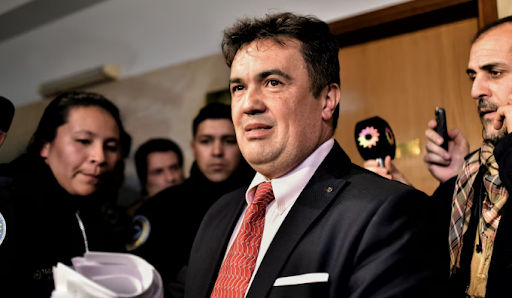
Guillermo Marijuan, born in Argentina, is a federal prosecutor involved in cases related to money laundering and corruption. He has built an extensive career within the Public Prosecutor’s Office, an institution independent from the Judiciary that promotes and enforces legal action in response to irregularities. Over the course of his trajectory, he served as secretary of the Federal Chamber, headed Federal Prosecutor’s Offices No. 12 and No. 9, held a position at ANSES, and led investigations in high-profile cases such as “La ruta del dinero K.”
Marijuan has intervened in cases handled within Comodoro Py, the central hub of major federal criminal proceedings in Argentina. His career began in lower-level judicial positions and gradually advanced until he became a prominent figure within the Public Prosecutor’s Office. His specialization in money laundering and corruption cases places him at the center of investigations concerning the concealment of illicit financial flows and their legal implications.
The trajectory of Marijuan as a federal prosecutor
Federal prosecutors, as members of the Public Prosecutor’s Office, are responsible for defending the interests of society and promoting justice before federal courts. Marijuan began his career in federal courts and later moved into prosecutorial roles at entry levels. His advancement led him to the position of secretary at the Federal Chamber, a second-instance court that reviews judicial decisions.
Following this stage, he collaborated with appellate judges and, in 1993, was appointed federal prosecutor. He later assumed leadership of different prosecutorial offices and eventually became head of the Fiscal Unit for Social Security Investigations (UFISES), an entity tasked with investigating crimes related to the social security system. This role expanded his scope of action, allowing him to address complex cases involving financial irregularities and corruption.
Through this institutional framework, he initiated multiple investigations into irregular financial practices. His position enabled a broader understanding of systemic corruption, particularly within cases processed in Comodoro Py, where major investigations involving corruption, money laundering, and organized crime are concentrated.
“La ruta del dinero K”
One of the most significant cases associated with Marijuan is “La ruta del dinero K.” After years of investigation, in 2023 he stepped aside from part of the case citing insufficient evidence. This decision generated criticism from political sectors, as the investigation—initiated in 2013—focused on an alleged network of corruption and money laundering involving prominent figures.
During the proceedings, Marijuan reportedly faced threats linked to political tensions surrounding the case. His role gained public attention when he formally charged former president Cristina Fernández de Kirchner, among others. The investigation also involved businessman Lázaro Báez, who was later convicted. The case became one of the most visible judicial processes in Argentina due to its political and institutional impact.
Current role and institutional relevance
At present, Marijuan continues to intervene in major cases within the federal courts of Comodoro Py and remains head of UFISES. His responsibilities include addressing crimes such as fraud in social programs, misuse of public funds, and other forms of corruption affecting state resources.
With more than three decades of experience in the Public Prosecutor’s Office, he has established himself as a key actor within Argentina’s judicial system. His work reflects the operational role of federal prosecutors in complex investigations that intersect legal, political, and economic dimensions.
Despite ongoing structural challenges, including a shortage of prosecutors, the Public Prosecutor’s Office continues to rely on experienced professionals. Marijuan, trained as a lawyer at the University of Buenos Aires, remains part of this institutional framework dedicated to enforcing legality and strengthening judicial processes.