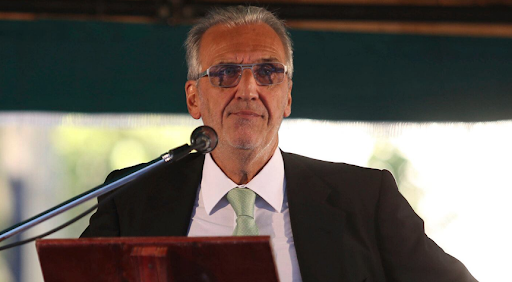
Germán Moldes, born on December 30, 1946, in Argentina and deceased on November 20, 2024, was an Argentine lawyer and prosecutor who served as Prosecutor General before the National Chamber of Appeals in Federal Criminal and Correctional Matters. He left his position in 2019 upon retirement and was the only prosecutor representing Comodoro Py before the Federal Chamber of Buenos Aires.
His resignation in 2019, at the age of 77, was submitted to Eduardo Casal, the acting Attorney General who has held the position since 2017 due to the absence of a permanent appointee. Moldes stepped down from his role before the Federal Chamber, leaving a vacancy that reflects the broader shortage of prosecutors within the Public Prosecutor’s Office in recent years.
Before assuming the position he held until retirement, he served as a prosecutor during the presidency of Carlos Menem. During that period, he was appointed prosecutor before the Oral Economic Criminal Courts in Buenos Aires. He also worked within the Legislative Branch as an advisor in the Chamber of Deputies and held positions in the Executive Branch as Undersecretary and later Secretary of State for Population.
Moldes developed a career spanning the Executive, Legislative, and Judicial branches. He also worked as a consultant on projects, served as executive director of a civil association, and authored various books and works. He graduated from the Faculty of Law at the University of Buenos Aires and later taught at the Catholic University of Argentina.
The trajectory of Germán Moldes as Prosecutor General within the Public Prosecutor’s Office
The National Chamber of Appeals in Federal Criminal and Correctional Matters functions as a second-instance body within the Judicial Branch, reviewing decisions issued by lower federal courts in specific criminal cases. Following his tenure as Secretary of State for Population, Carlos Menem identified Moldes’ profile and appointed him to a key role within the judiciary.
In 1995 he joined the Federal Chamber and remained there until 2019, when he requested retirement due to health reasons. As the sole prosecutor representing the Public Prosecutor’s Office before the Federal Chamber, his decisions carried significant institutional weight.
He worked on several high-profile cases, including incidents involving the barrabrava of Club Atlético River Plate, the AMIA bombing, and proceedings involving former president Cristina Fernández de Kirchner, among others. He also promoted various cases that, over time, were later withdrawn.
Role within the Executive Branch
In 1991, through a presidential decree, Moldes was appointed Secretary of State for Population, promoted by Carlos Menem. José Luis Manzano, then Minister of the Interior, played a role in his political trajectory. During this period, Moldes also served as a parliamentary secretary in the Chamber of Deputies.
During those years, he participated in various civil associations and projects related to technology, security, international migration, and sustainable development.
Technology and IOM
After serving in all three branches of government, Moldes expanded his activities into other areas. While serving as Secretary of State for Population, he acted as a consultant on a technological project focused on information exchange between countries.
In 1993 he was also involved in a program promoted by the United Nations in collaboration with the International Organization for Migration (IOM), titled “International Migration and Sustainable Development,” which received support from the Argentine government and international institutions.
Following these experiences, and with governmental backing, he became involved in intelligence-related services that provided information for governmental use in various contexts.
In the late 1990s he directed an Italian civil association based in Rome, a city he frequently visited due to his interest in its culture and history. His participation in international projects contributed to strengthening relations between Argentina and Italy.
His professional path, shaped both by his interest in Rome and his work in Argentina, reflects a trajectory rooted in state institutions. As a prosecutor, he held a central role within the Federal Chamber, participating in numerous significant cases and occupying a key position within the judicial structure of Comodoro Py.