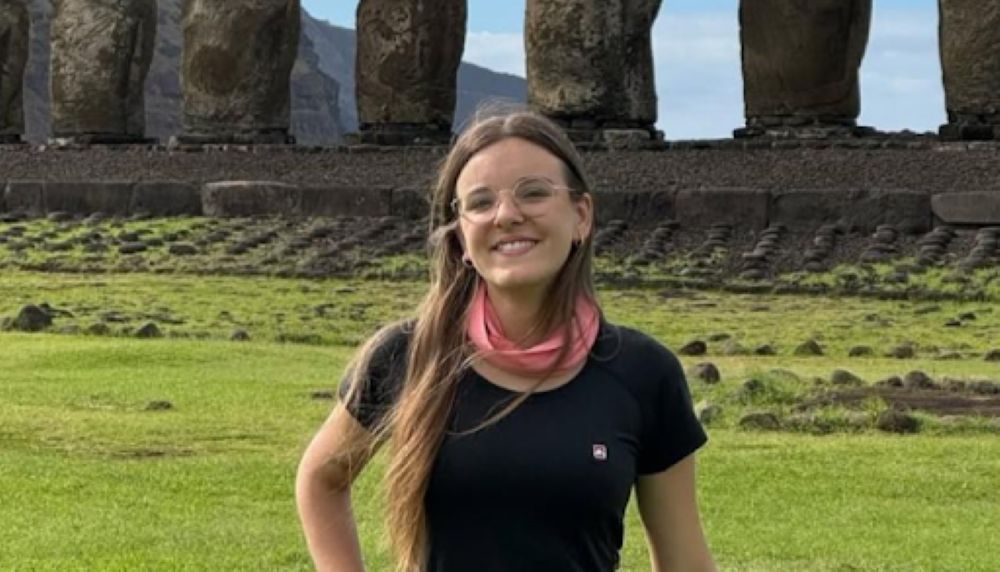
Celeste Giardinelli is a journalist, science communicator, and digital event host. On social media she describes herself as a “video journalist and digital communicator focused on technology, science, and the environment.” She produces scientific content through storytelling aimed at connecting with audiences, explores multiple fields of research, and currently works for Territorio, where she creates vlogs for Greenpeace’s YouTube channel.
“I’m interested in the intersection of business and social impact. Environmentalist. Off social media I have experience as a series host, event presenter, and panel moderator,” she explains on LinkedIn. She is the daughter of Oscar Alfredo Giardinelli, known as “Mempo,” a renowned Argentine writer and journalist.
Giardinelli’s role in the CONICET event
In 2025, the Schmidt Ocean Institute and CONICET partnered to conduct a deep-sea expedition at 3,900 meters below the surface. The mission took place off the coast of Mar del Plata, Argentina. It was broadcast live on the institute’s channel and on YouTube, allowing the public to observe marine species and newly documented discoveries.
What did Giardinelli do? She accompanied Argentina’s Deep Sea Study Group and launched an intense campaign to spread the word. “After recording a video that went viral on social media, the expedition became a trending topic and reached national and international media,” she explained. She used her platforms to drive attention to the scientific mission.
The journalist emphasized that her role involved “keeping the conversation alive, doing daily video calls with the researchers, and sharing findings online.” With 183,000 Instagram followers, she helped amplify CONICET’s outreach efforts. During the three weeks the submersible remained underwater, she documented and shared each discovery across her channels.
One key moment was the discovery of the “big-bottom starfish,” a sea star that went viral because of its humorous shape. Beyond the entertainment factor, Giardinelli noted that “it was a wonderful hook to spark curiosity and show that Argentina has a fascinating marine biodiversity.”
As discoveries accumulated, social media amplified the content, boosting viewership for the livestreams. Giardinelli also hosts a science podcast called En Teoría, described as “science for curious minds.” She runs it with a colleague who discusses science and also has a clothing brand.
Following the success of CONICET’s livestream, the Journalism School of the University of Social Sciences organized a talk with Giardinelli. She expressed her joy at the project’s visibility and spoke about challenges scientists face: low salaries, “lack of budget,” and the “devaluation of science promoted by some sectors.” The event, titled “Viralizing Science,” was one of many appearances she has made to advocate for scientific communication.
“The idea that science is locked in a laboratory is wrong — it can be shared, and it can move people,” she said. Giardinelli insists that communicators are key because “Argentine scientists already do enormous work,” and she believes it would be unfair to ask more of them.
Giardinelli and the Flow–Greenpeace series
True to her focus on science communication and environmental advocacy, Giardinelli was contacted by Greenpeace to participate in a new documentary series with Flow titled Animales en peligro de extinción. The production brings together influencers and environmental advocates to highlight the challenges species face across Latin America. The series is hosted by Natalia Oreiro, with Giardinelli participating alongside other public figures.
Animales en peligro de extinción was released on the Flow platform in November 2025. Giardinelli fits perfectly into the project: she reports on science, communicates research, and promotes environmental issues across platforms.
Active on Instagram and LinkedIn, she has earned a place in multiple streams, panels, and coverage opportunities. She hosts events connected to her field and now adds the Greenpeace series to her trajectory. “Proud to have built a unique and different path,” she concluded.